
Behind the Scenes: How We made the Bakersfield episodes
May 15, 2026
The Ultimate America 250 Historic Road Trip: Boston to Washington, D.C.
June 1, 2026Happy centennial to Route 66!
For road trippers looking at making the journey, here are some ideas about how to spend your time in the state with one of the smallest stretches of 66–but some of the most memorable.
By the time you reach Texas on Route 66, you’ve already crossed several states and time zones, but the 178 miles of the Lone Star State has three of the most memorable and important photo spots.
Texas on 66 is three acts, and even though it’s just a basic three to four hour drive, I wouldn’t do it in one day. Stay overnight in at least one stop, if not two.
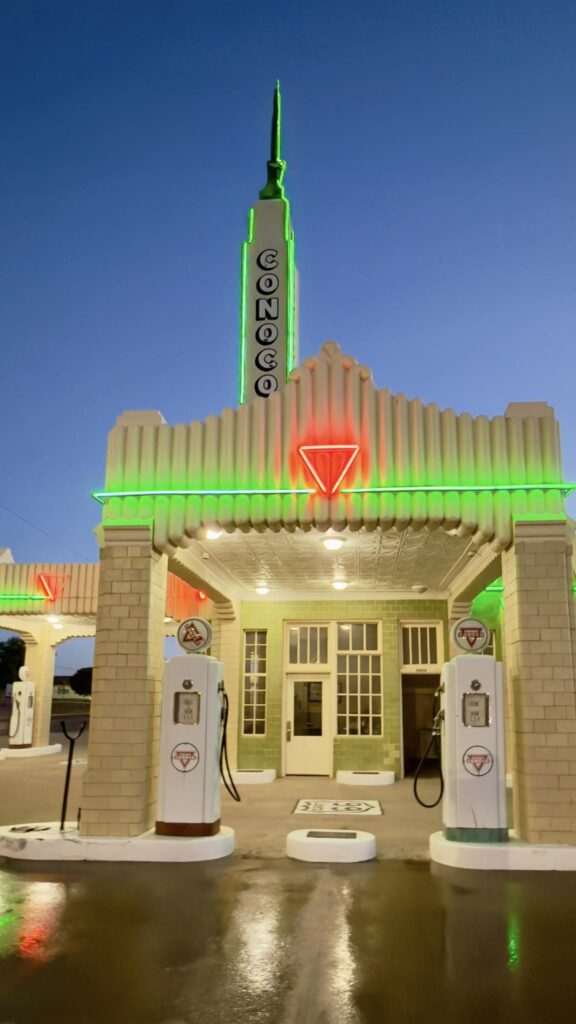
Act I: Shamrock – Neon in a Ghost Town
You know you’ve crossed into Texas, but Shamrock doesn’t exactly scream for attention. Population 1,700. You can drive the whole town in under three minutes—if you’re in a hurry. You shouldn’t be.
Shamrock is home to the iconic UDrop-Inn Cafe. More on that in a minute.
Shamrock grew up along the railroad in the early 1900s, and when Route 66 opened in 1926, the new highway brought truckers, dreamers, and families in Chevys and Fords right through town. Today, the traffic has thinned out, but the star attraction still glows: the aforementioned 1936 U-Drop Inn, an Art Deco tower of green and cream that looks like it was built to be photographed.
If it seems familiar, it probably is. Pixar’s animators used this very building as the model for Ramone’s Body Shop in Cars, giving a little café in a tiny Texas town a worldwide close-up. It’s also one of the rare Route 66 icons immortalized on a U.S. postage stamp, proof that this place isn’t just a roadside stop—it’s part of the national memory.
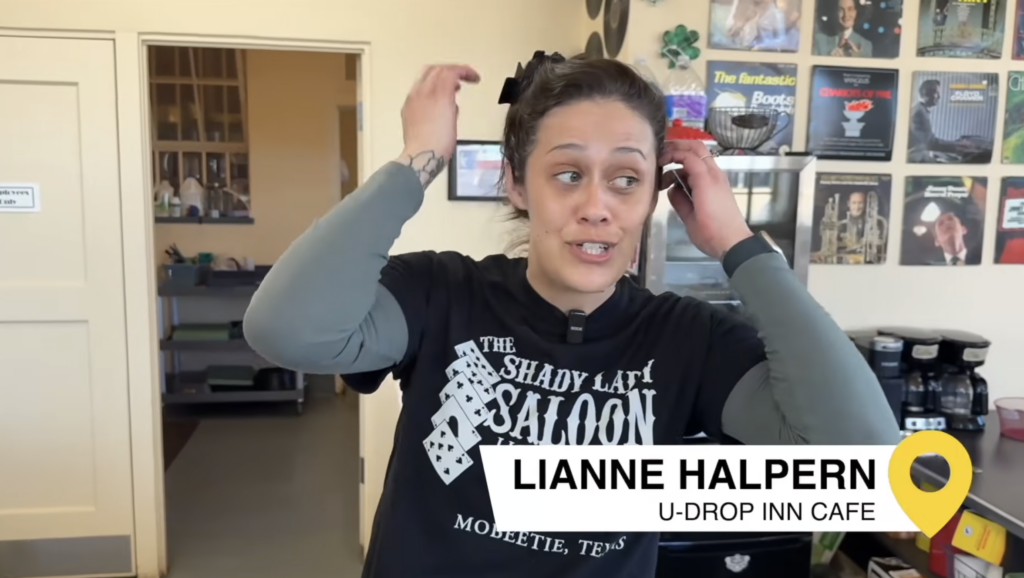
Inside, the quiet of the street disappears. Co-owner Lianne Halpern tells us she doesn’t “look this put together because it’s slow,” and the guest book backs her up: Alabama, Spain, Canada, France, Australia, Belgium, England, Slovenia, Portugal—all in just a few days. When she asked a European visitor why they’d travel all the way to a place like Shamrock, he answered with a line that sticks with you: “Egypt has the pyramids. America has Route 66.”
Out on the street, Shamrock goes back to its default setting: silence. A few antique and curio shops. Vintage motels and old gas stations lining the highway. Long, empty blocks where you can stand in the middle of the road, camera in hand, and imagine Packards and Studebakers rolling by in the 1940s and 50s. For anyone who loves small-town Americana, this is the moment you pull over and let the stillness do the talking.
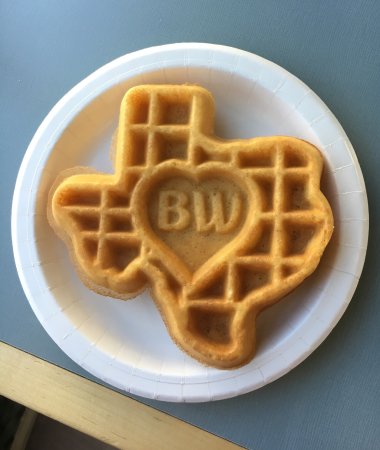
If you overnight here, which again is recommended, the local Best Western leans into the Texas thing right down to the cooked to order breakfast and waffles shaped like the state at breakfast. Stay overnight and you’ll have time to get great neon shots of the UDrop at night and early morning.
Act II: Amarillo – Spray Paint, Steak, and Neon
Two hours west, the quiet of Shamrock gives way to Amarillo’s louder brand of Route 66. Before you even hit downtown, a line of half-buried cars in a field pulls you off the highway: Cadillac Ranch.
Ten Cadillacs, ranging from 1949 to 1963, are planted nose-first in the Texas dirt at the same angle as the Great Pyramid of Giza, a surreal idea dreamed up in the 1970s by a San Francisco art collective called the Ant Farm. They wanted to say something about American car culture and the Cadillac’s rise as a symbol of status, tail fins and all.
Originally, the cars were just…cars—solid colors, faded paint. Then visitors started tagging them. Instead of fighting the graffiti, the artists embraced it, and Cadillac Ranch evolved into a piece of living, layered art where every traveler gets to add a few more colors to the pile. Most people use only part of a spray can and leave the rest behind, so even if you arrive empty-handed, chances are you’ll find enough paint on the ground to leave your mark.
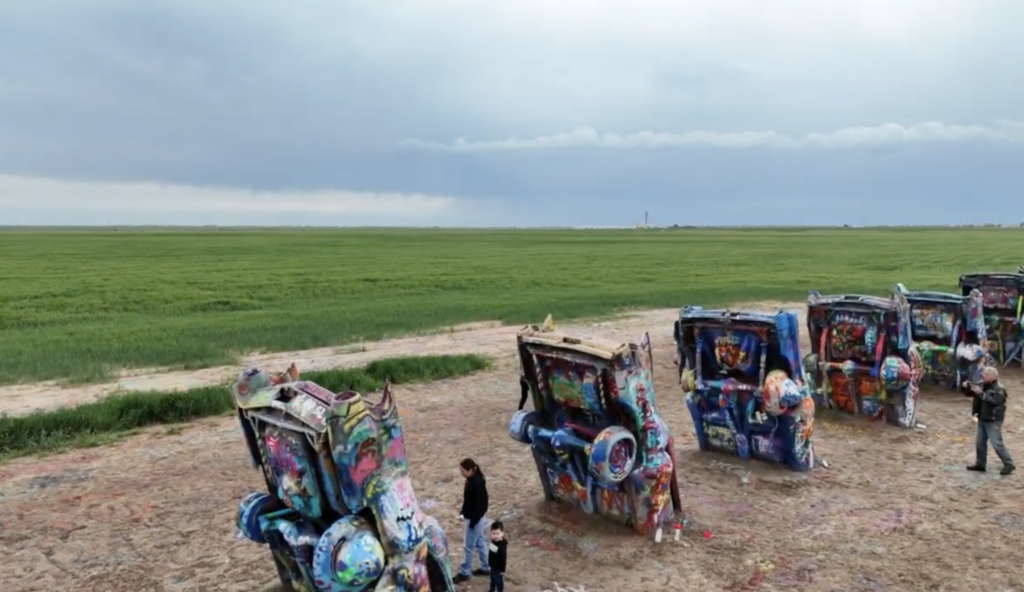
A local tells us it’s a “once in a lifetime thing” you simply have to do if you’re coming through Amarillo, and she’s right. There’s something strangely moving about spelling your name on a car that’s already wearing thousands of names, knowing it will disappear under fresh paint in a day or two.
A few miles away, the Big Texan Steak Ranch trades spray paint for steak juice. Since the 1960s, it’s been home to the 72-ounce steak challenge: finish the steak, shrimp cocktail, baked potato, salad, and roll in under an hour and the meal is free. Fail, and you’re out 72 dollars and a lot of pride. We ordered the modest eight-ounce steak and split it—it was that big. So much for 72 ounces!
We stayed overnight at the local Best Western, which allowed us to go out to dinner at the Big Texan without having to move on, and explore Amarillo 66 in the morning.
In Amarillo’s historic Route 66 district along 6th Avenue, the road narrows, the speed limits drop, and the neon signs and storefronts feel like they’ve been waiting for you since 1959. Antique shops, murals, old businesses with fresh coats of paint—it’s one of the best-preserved stretches of 66 in Texas and a perfect place for a slow walk as the sun goes down.
Act III: Adrian – Exactly Halfway to Everywhere
From Amarillo, the road unwinds west into wide-open country. Eventually you reach Adrian, a tiny backroads town with a very big claim: the official midpoint of Route 66.
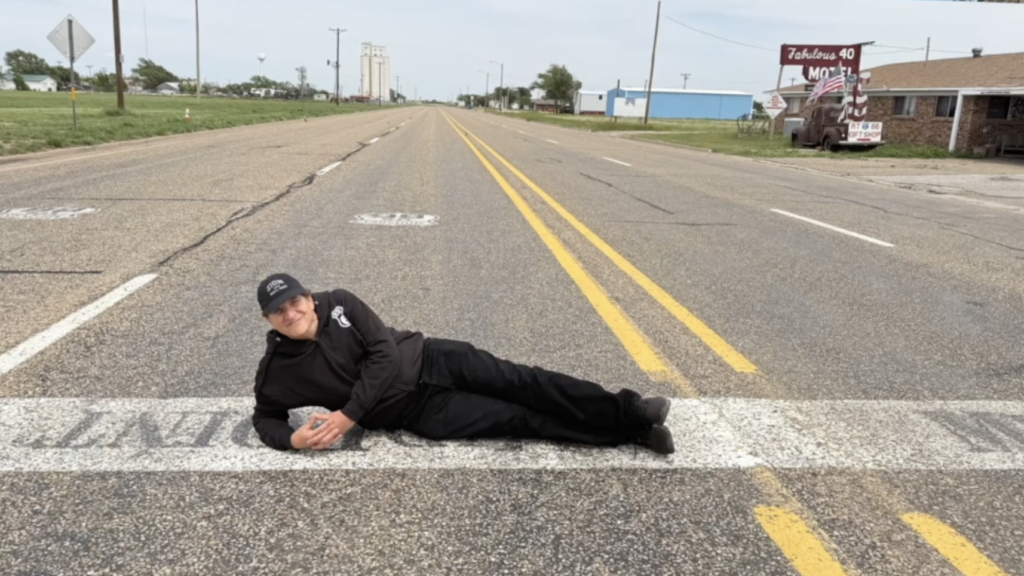
A white line across the road and a simple sign tell the story: 1,139 miles to Chicago in one direction, 1,139 miles to Los Angeles in the other. For travelers doing the full run, this is more than a roadside marker; it’s proof that the dream is real, that you’ve actually made it this far.
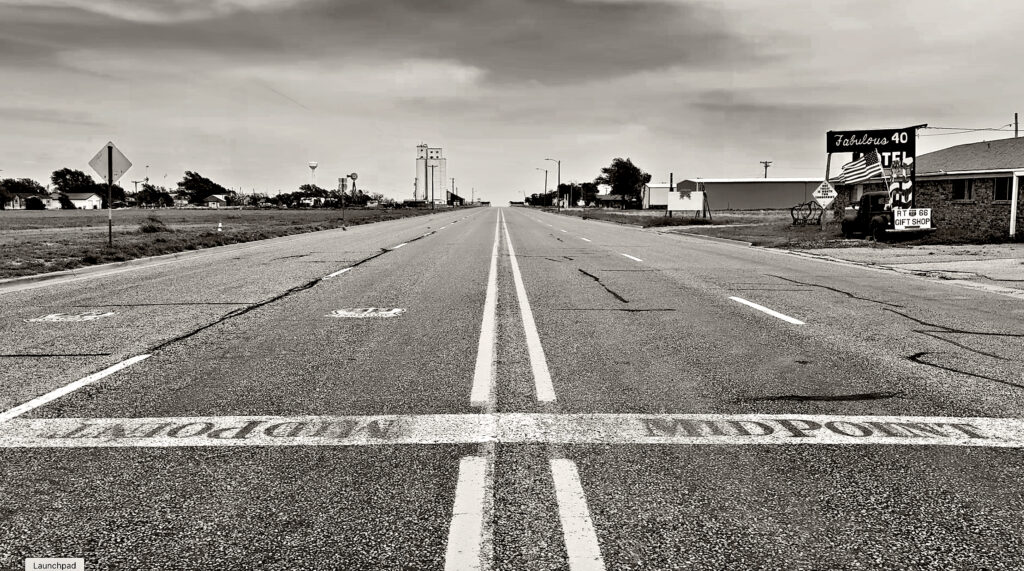
There is a hotel or two in the area, but you don’t need to call it a night here. There’s not much to do beyond getting your photo in the middle of the street and visiting the great Midpoint Cafe (be sure to check their hours before you arrive.)
The Midpoint Café has been feeding travelers since 1947 and is famous for its “ugly pies”—desserts that might not win a beauty contest but absolutely win on taste. After pie comes the ritual: step outside, pose by the midpoint sign, then wander into the middle of the road for the classic shot standing on the dividing line.
It’s so quiet you can stand there, or lie flat on the asphalt like we did, without worrying about traffic from either direction. In a world of constant noise and motion, that kind of silence feels almost unreal.
From here, next stop is the New Mexico state line about 20 minutes away and the neon rich town of Tucumcari, where you will definitely want to spend the night.