 Scripps News
Don’t Drive Past Charming Minnesota Small Town Isanti
September 20, 2026Minneapolis is best known to many visitors as the hometown of Prince, the city where Mary Tyler Moore famously tossed her hat into the air, and the birthplace of the cheese-stuffed Jucy Lucy. But what struck me while filming a Photowalks episode there was just how much there is to photograph: lakes and waterfalls, the Mississippi River, historic flour mills, old neon and ghost signs, striking architecture and one of the best urban riverfronts in America. If you’ve got a day—or better yet, two—here’s the Photowalks itinerary.
Morning: Start with the Minneapolis waterfront
Begin at the Guthrie Theater, 818 S. 2nd St., Minneapolis. You don’t need a theater ticket to enjoy one of its best features: head up to the fourth floor and walk out onto the Endless Bridge for a terrific elevated view of the city and Mississippi riverfront. The building itself is open to visitors, although public hours vary by day and performance schedule.
From there, walk next door to the Mill City Museum, 704 S. 2nd St., Minneapolis. Minneapolis was quite literally built on flour: wheat from Minnesota farms came into the city’s mills, and the finished flour was shipped around the country by rail. Even if you don’t go inside, the surviving grain bins and the huge old Gold Medal Flour sign make great photographs.
Then continue to the Stone Arch Bridge, 100 Portland Ave., Minneapolis. Walk far enough across to turn around and photograph the bridge leading your eye toward the Minneapolis skyline. It’s one of the signature views of the city. The bridge connects the Mill Ruins Park side of the river with Father Hennepin Bluff Park on the east bank.
Photowalks tip: Come back here after sunset. That’s when the skyline lights come on and the sky still retains some color. We photographed it both ways for the episode, and the difference is dramatic.
Late morning: Get out to the lakes
Minnesota may be the Land of 10,000 Lakes, but Minneapolis itself has 22 lakes. We visited Bde Maka Ska, the city’s largest, at 3000 Bde Maka Ska Parkway, Minneapolis. You’ll find people walking, running, biking, picnicking and enjoying the water—all within the city. The park has walking and biking paths, beaches, picnic areas and parking.
This is also a good place to try one of my favorite iPhone tricks. Take a photo of moving water with Live Photos turned on, open the image and apply the Long Exposure effect. It can turn rippling water into a smooth, silky-looking photograph. You may need several attempts to get one you like.
Another essential outdoor stop is Minnehaha Falls at Minnehaha Regional Park, 4801 S. Minnehaha Drive, Minneapolis. It’s one of the city’s most popular and photogenic landmarks and an easy place to work a waterfall into an otherwise very urban Minneapolis itinerary.

Lunch: Eat a Juicy Lucy
You can’t do a Minneapolis itinerary without trying the city’s famous inside-out cheeseburger.
We went to Matt’s Bar (3500 Cedar Ave. S) where American cheese is placed between two hamburger patties before they’re sealed together and grilled. The result is the Jucy Lucy—and there’s one important rule: don’t take a huge first bite. That molten cheese is hot. I learned this on camera. Pasted markdown
If you don’t eat meat, Matt’s also serves a grilled cheese for under $5.

Afternoon: Sculpture, signs and a global market
Head to the Minneapolis Sculpture Garden at the Walker Art Center, 725 Vineland Place, Minneapolis, MN 55403, for another Minneapolis icon: Spoonbridge and Cherry. The enormous spoon stretches more than 50 feet and the cherry weighs roughly 1,200 pounds. The garden is free and open daily.
Then take a detour to the Midtown Global Market, 920 E. Lake St., Minneapolis, MN 55407, located in the former Sears building. We found restaurants representing cuisines from around the world and tried Manny’s enormous house-special torta, loaded with steak, onions, tomatoes, jalapeños, cheese, mushrooms, ham, avocado and chipotle mayonnaise.
Keep your eyes on the surrounding buildings. Minneapolis has some wonderful ghost ads–faded advertisements painted directly onto brick walls more than a century ago. Local photographer Jay Grammond, author of Fading Ads of the Twin Cities, showed us how these signs functioned as the billboards of their era and how easy they are to walk past without noticing.
Cross over to St. Paul
Minneapolis is only half of the Twin Cities, so leave some time for neighboring St. Paul.
Among its highlights is the Minnesota State Capitol, 75 Rev. Dr. Martin Luther King Jr. Blvd., St. Paul, MN 55155, along with historic architecture, the Mississippi River setting and a downtown that feels noticeably quieter than Minneapolis. The Cass Gilbert-designed Capitol is open to visitors and offers tours.
If you have two days rather than one, I’d make this the dividing point: devote your first day to Minneapolis and spend part of Day 2 exploring St. Paul.
Sunset: Back to the river
Finish where you started.
The Stone Arch Bridge and Minneapolis riverfront become completely different photographic locations around dusk. Don’t leave immediately after the sun disappears. Wait about 30 minutes after sunset, when the sky deepens, signs and bridges are illuminated and the lights begin coming on in the downtown buildings.
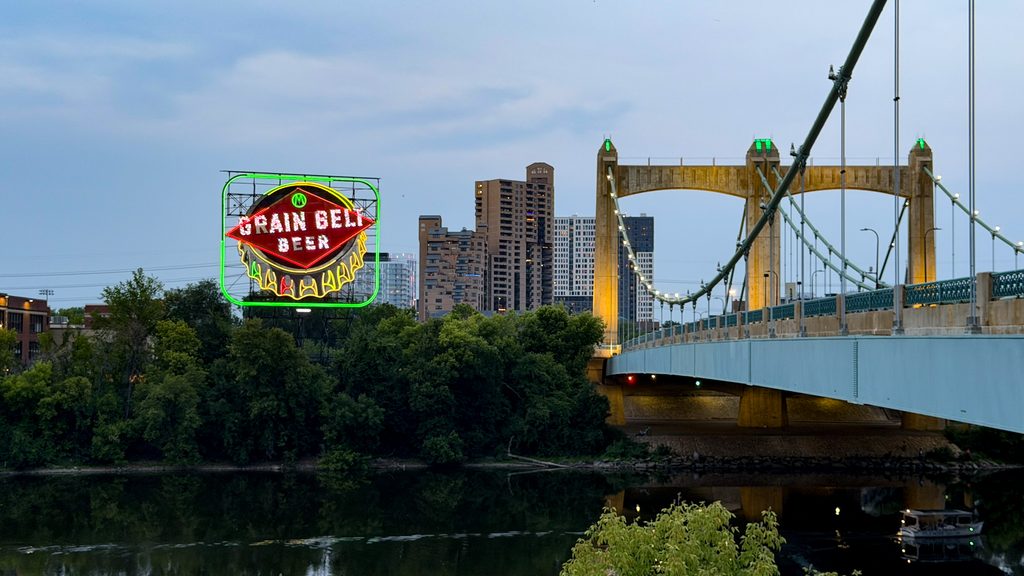
Also photograph the historic Grain Belt Beer sign from the west side of the Hennepin Avenue Bridge. The giant bottle-cap sign sits on Nicollet Island, but this is the view you want, particularly after dark when the neon is illuminated.
That’s the larger lesson I came away with while photographing Minneapolis: timing matters as much as the camera. The same skyline that can look fairly ordinary in midday light can become spectacular after sunset. And you don’t need an expensive camera to get it—I shot every frame of our Minneapolis episode on a phone.